If you have questions after reviewing the below information, please reach out to any of the Airstream Club Members listed here, as they would love to have a conversation with you!
Tom Smithson, BRN 777 CBLchair@wbcci.net 916-802-0443
Jim Cocke, BRN 4822 wbbyjim5@gmail.com 704-430-9192
Jenny Schnettler, BRN 6594 jenndo1956@gmail.com
Kathy Geese, BRN 2391 kathygeese@gmail.com
MEMORANDUM (click here for PDF version)
DATE: Wednesday, May 4, 2022
TO: All Membership
FROM: Airstream Club International Headquarters
SUBJECT: Constitutional Amendments #1 & #2
INTRODUCTION: Headquarters has compiled the following memo to summarize our members’ questions along with pros and cons regarding Constitutional Amendments #1 and #2. Each item has been thoroughly researched and verified through factual operating evidence to help our members gain a complete understanding of the proposed amendments and their impact.
These amendments have been passed by the International Board of Trustees (IBT) to membership for an all-member vote to be brought by local club delegates to the IBT meeting on July 27, 2022.
Constitutional Amendment #1
DEFINITIONS:
Constitutional Delegates Meeting: the annual meeting of delegates to vote on Constitutional Amendments
Delegate: the individual who is sent to the Constitutional Delegates Meeting to report the votes coming from its local club. The delegate is usually the local club president, or an alternative representative if the president cannot be present at the Meeting.
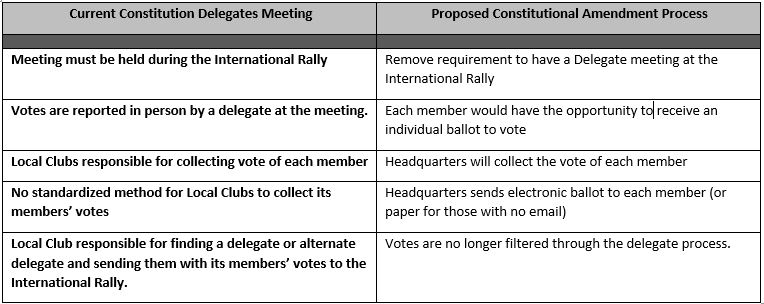
WHAT IS THE PROPOSED CHANGE?
WHY IS THE CHANGE BEING PROPOSED?
- Gives all members the opportunity to vote on proposed amendments
- Removes the job of collecting votes from the local clubs
- Decouples Club business from the International Rally
- Allows for a shorter timeline to process a Constitutional Amendment
WHAT IS THE BENEFIT TO ALL MEMBERS?
- Each member can be involved in the discussion of any proposed Constitutional Amendment
- All members would individually receive a ballot to vote on any Constitutional Amendment
FAQs:
Q1: How would the new voting process be handled without delegates?
A1: Each member would receive a ballot to vote. The ballots would arrive via email except for those who request a paper ballot.
Q2: Would the new voting process cost more than the delegates meeting?
A2: Providing electronic ballots to members would be about a quarter of the cost of having the in person meeting at the International Rally.
Constitutional Amendment #2
DEFINITIONS:
Executive Committee (EC): the administrative branch of our Club; the Officers plus the immediate Past International President, serving as part of the International Board of Trustees (IBT).
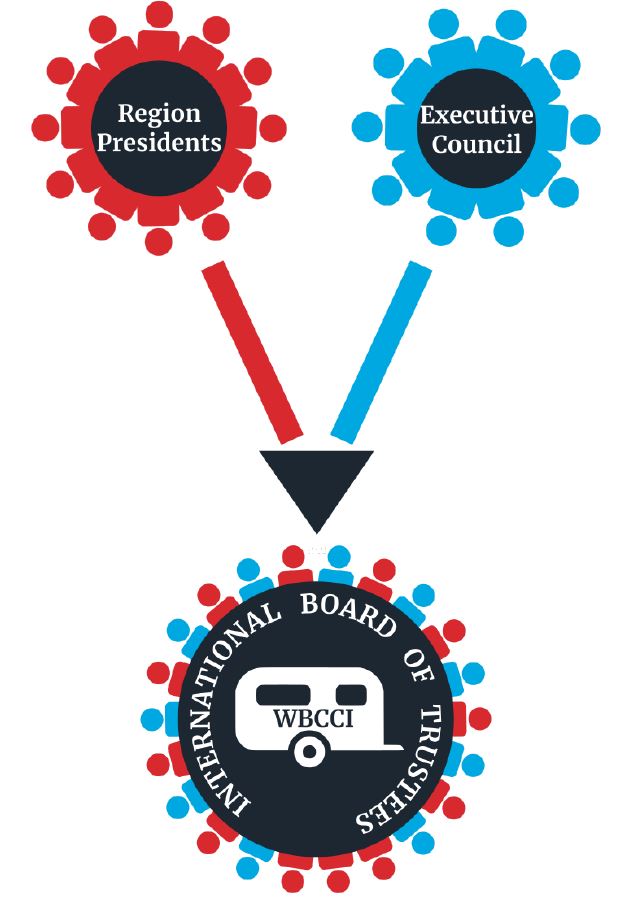
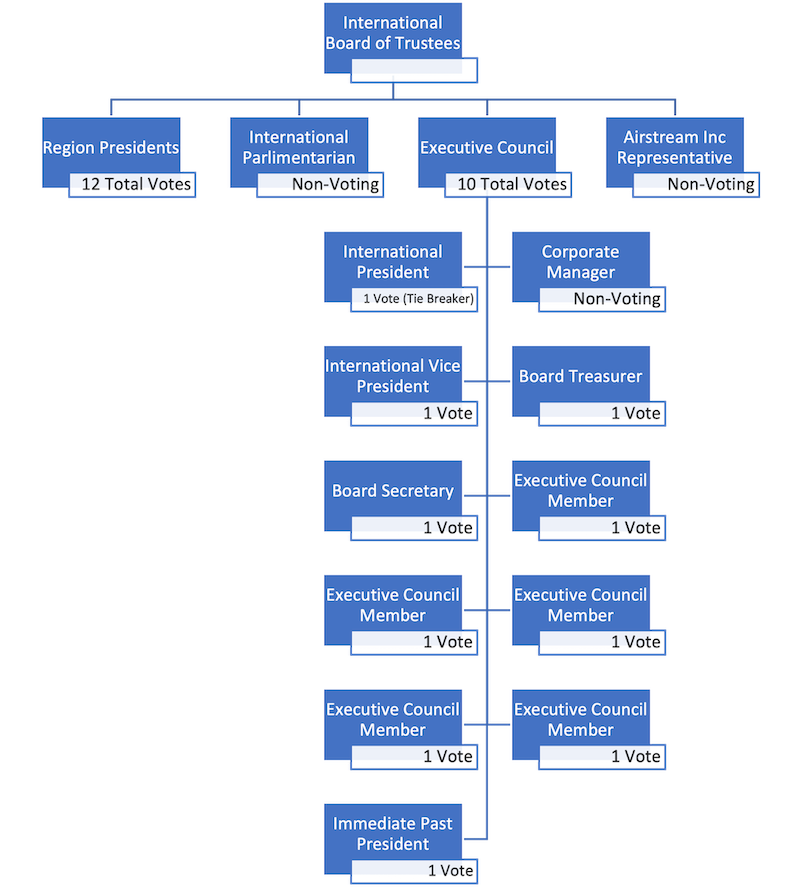
International Board of Trustees (IBT): the larger governing body of our Club, comprised of 12 Region Presidents plus the EC.
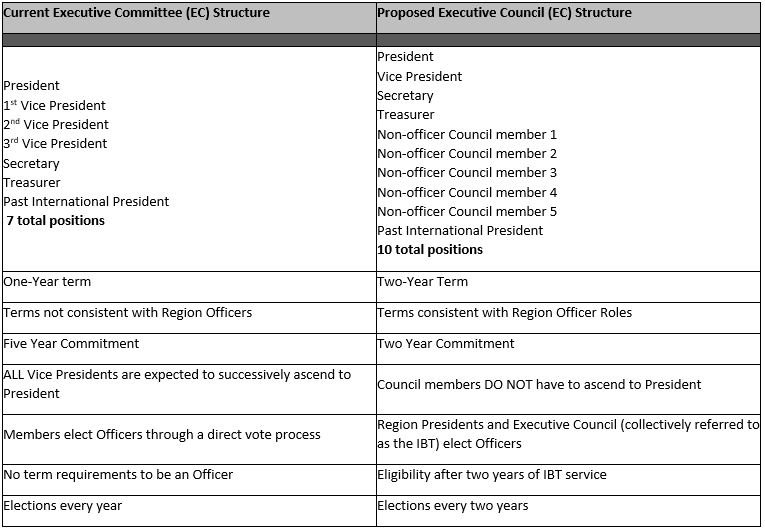
WHAT IS THE PROPOSED CHANGE?
WHY IS THE CHANGE BEING PROPOSED?
- The current structure is antiquated and flawed to meet the needs of the growing membership and business of the Club today.
- Allows members the opportunity to serve on the Council who want to give to the Club but are not necessarily interested in becoming President and/or unable to make a 5-year commitment.
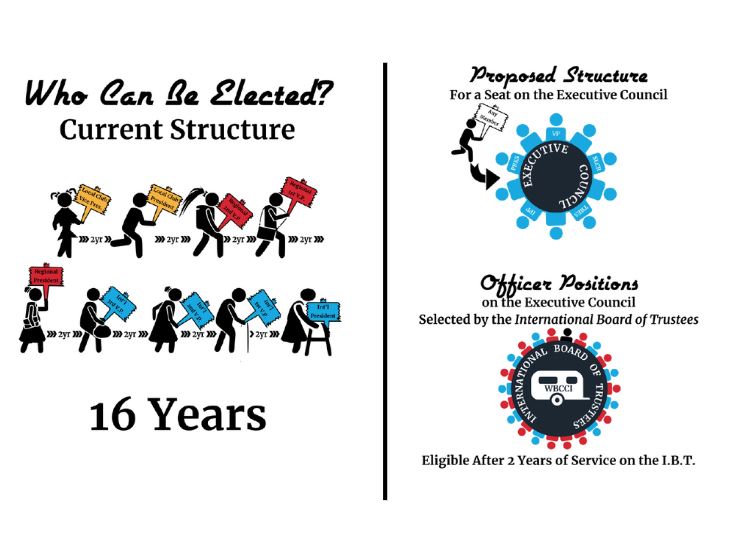
- The new term would require two years of service. Current Executive Committee members’ total commitment is five years.
- Allows Council members to perform and complete goals after the first-year learning curve by continuing on a second year.
- Easier to recruit for a short-term commitment.
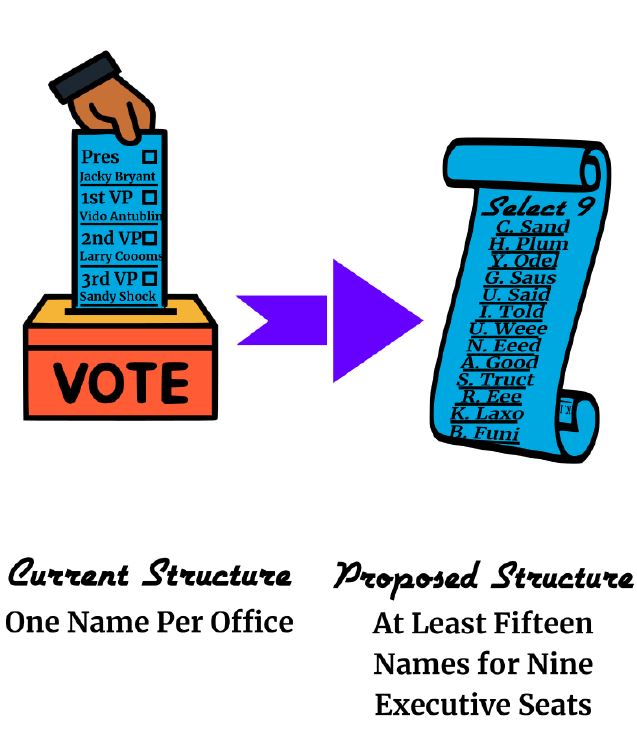
- Provides voting choices to general membership during the election for Executive Council Members rather than offering up a single choice for Officers, as we do now.
- Training for Council members on collaborative team building is needed in today's business
- The current process no longer meets the needs of our growing Club, as it is more complex than in past years.
- Invites more input from our membership on our leadership by requiring ALL Council members to be elected by the general membership every two years (with exception to the Past International President) vs. the current automatic incumbent succession.
- Lessens the disruption of good service to our Club by allowing Council members to serve more than one term IF the membership votes them in.
- Eliminates the expectation for Committee members to ascend to the Presidency.
- Two-year terms would allow for better long range strategic planning for the Club
- Utlilizes the expertise of Region Presidents to represent the best interests of their members along with personal knowledge of their fellow IBT members when voting for Officers
- Enlists a larger team to provide a more diverse set of skills and knowledge that our leaders are not currently required to have.
- Provides an up-to-date structure to conduct long term strategic business operations instead of starting on a new goal each year.
WHAT IS THE BENEFIT TO MEMBERS?
- Member participation in Club business without a long-term commitment
- Add additional talent to expand and assist standing committee, International Club needs and local clubs with programs such as:
- Preserve and promote Wally Byam and the Airstream Club
- Caravans
- National Rallies
- Communication
- Technology support
- Marketing
- Financial skills
- Event coordination
- New member campaigns and member retention
- Membership benefits
- Outreach to help local clubs with any help they need – Officer recruitment, membership retention, better rallies, etc.
FAQs:
Q1: Who is planning and coordinating the International Rally?
A1: International Rally planning has been transferred to headquarters with full transfer in place by 2023.
Q2: How did the committee grow from looking at two-year terms to proposing a total restructure?
A2: If there was no change in Executive Committee structure, international service would double from 5 to 10 years. Recruiting would become even more difficult because of the long commitment. This would severely deter working members from participating. Restructure would reduce time commitments and increase potential candidates. The restructure provides opportunity to serve without committing to a multi-term track.
Q3: Why is this moving so fast?
A3: The committee has been evaluating the restructure for a year and now there is a blitz to educate the membership since members only get to vote on Constitutional Amendments once a year. More than 21 Club members have been working on the restructure process since July of 2021. The team has spent countless hours fleshing out the proposed structure. In January of 2022, our Club’s International Board of Trustees passed the proposal along to membership to begin to learn about the new proposed structure. The work on the new proposal was not rushed, but there is a rush to get members educated on the topics prior to the delegate vote on July 27, 2022.
Q4: How soon would the new structure start?
A4: The amendment would become effective August 1, 2022. There would be a transition year between August 1, 2022 to July 31, 2023. The first elections for the new Council structure would be in the spring of 2023, with the Executive Council members starting on August 1, 2023.
Q5: What happens to the Officers elected in 2022 during the transition year?
A5: The President would be International President, 1st Vice President would be Vice President, Recording Secretary would be Recording Secretary, Treasurer would be Treasurer. The 2nd Vice President and the 3rd Vice President would have a seat on the Executive Council.
Q6: What happens if a member of the Executive Council is not doing a good job?
A6: The removal of an ineffective Executive Council member can be done by a 2/3 vote of the IBT.
Q7: What are the duties of the new Executive Council members?
A7: Each Council member would be assigned as a liaison to special committees, programs and projects for our Club. This is so the IBT can hear and serve the needs of our membership.
Q8: Do I have to be President if I run for the Executive Council?
A8: No, you do not ever have to be the President or an Officer to be part of the Executive Council.
Q9: What is the maximum number of years someone could be elected to the Executive Council?
A9: Six years, ONLY if elected by the membership every two years. No one shall serve more than three elected terms on the Council. Officers may serve a maximum two terms in any Officer role.
Q10: What if more than one person wants to run for International President?
A10: It is the hope there would be more than one candidate to give IBT members a choice.
Q11: It used to take five years to be International President; would the restructure make it 10?
A11: No, after serving for two years, an Executive Council member is eligible to run for President. Also, any Region President can run for IBT President after completing their two-year Region Officer President term.
Q12: Would Officers be guaranteed a spot on the Executive Council if they want to serve a second term?
A12: No, the Officer would have to be re-elected by the membership to serve a second term on the Executive Council and then be elected by the IBT into that position for a second term.
Q13: What is the financial impact of adding additional Executive Council members?
A13: The cost would be minimal if any for the incidentals the Club supplies the Executive Committee members. With the new structure, the Club would actually save about $300 a year.
Q14: Would the cost of travel for the Executive Council members change?
A14: The budget committee determines the travel budget for all Officers each year, and not all Executive Council members would be assigned travel. It would depend on what the budget allows.
Q15: Can the International President still handpick the secretary and treasurer?
A15: No, the membership would vote on the candidates for the Council, and the IBT would elect the secretary and treasurer.
Q16: Would all membership vote directly for International Officers?
A16: No, the membership would vote on the candidates for the Council (with exception to the Immediate Past International President). The members serving on the IBT would elect the Officer positions. Region Officers would be responsible for representing their membership’s opinions on International Officers.
Q17: How would the Executive Council hear input from the membership?
A17: Several avenues are available for members’ voices to be heard. Work with your Region Officers and use the comment forms, voicemail or email available through Headquarters year-round.
Q18: Would the Vice President of the Executive Council automatically become President?
A18: No, that member could run for President but would have to be elected by the IBT.
Q19: Shouldn’t the club honor the commitment to the current Vice Presidents who planned on being President?
A19: The current Vice Presidents still have the opportunity to become International President; it would just be on a different path. There would not be a guarantee that a Vice President would become President (because any member who has served two years on the IBT can run against them). The IBT would elect the President they deem best suited to represent the interests of membership and cohesively lead our Club.
Q20: Does this change the Region or Local Club Officer roles?
A20: No.
Q21: Do the 12 Region Presidents continue to have the 12 votes they had previously?
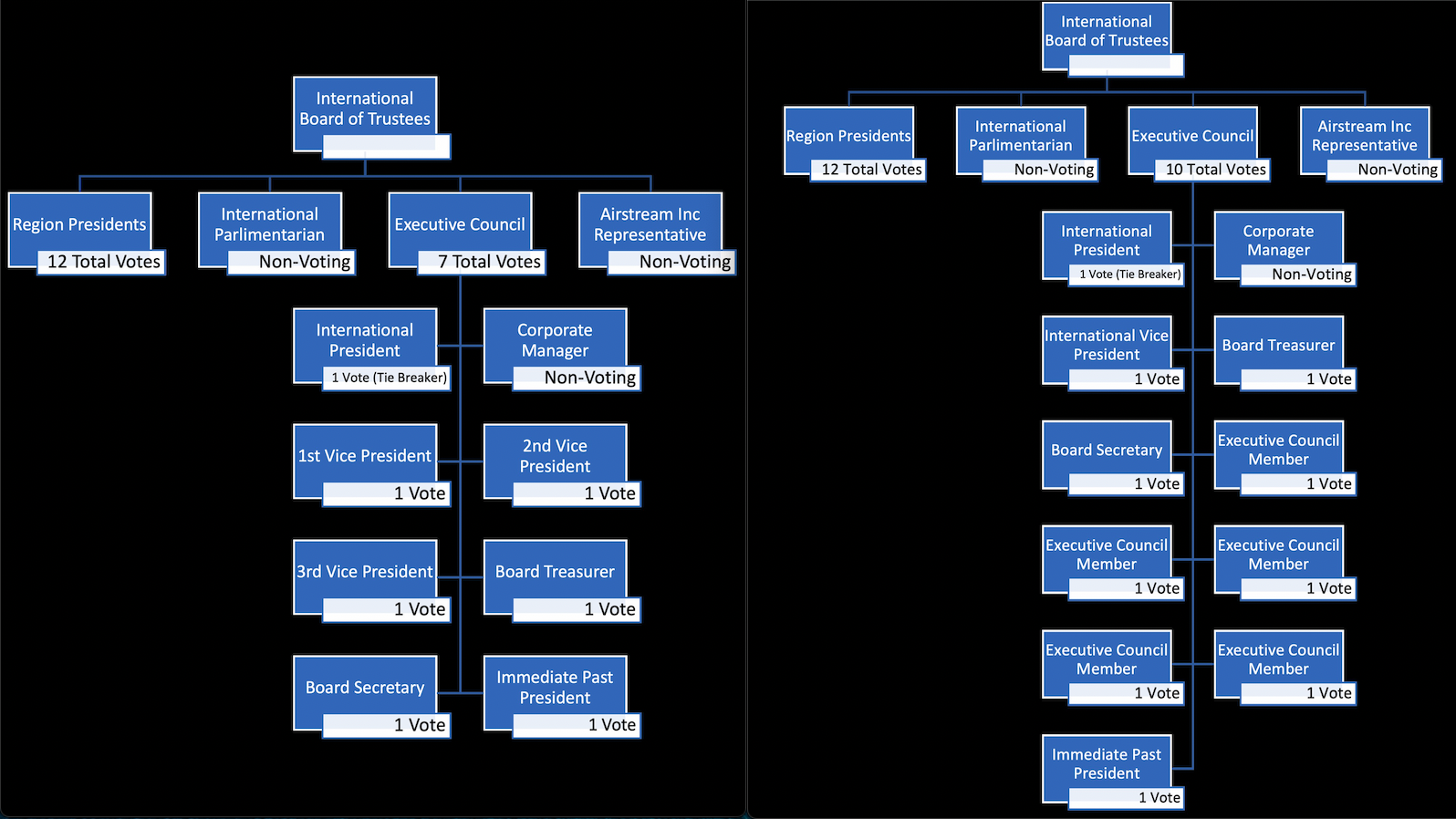
A21: Yes, they will maintain having 12 votes on the International Board of Trustees and the Executive Council would have 10 votes, including the President, who only votes in case of a tie.
Q22: What’s being done to prevent Region Officers from skipping out on their terms to run for the Executive Council?
A22: The new structure discourages the possibility for a Region Officer to depart from their two-year Region Officer role, since no member would be eligible to run for an Officer Position without first serving a two year term on the IBT.
Q23: I am a Region President and want to run for the Executive Council, and my term ends in an even year. How soon could I run for the Executive Council?
A23: You could immediately submit your resume to the Nominating Committee for the next election cycle that would take place during an odd year.
Q24: I am a Region President and want to run for the Executive Council, and my term ends in an odd year. How soon could I run for the Executive Council?
A24: You could submit your resume to the Nominating Committee and run for the Executive Council while still serving as a Region President. If you are elected, your term would start at the end of your Region President's term.
Q25: Currently, the Nominating Committee has difficulty recruiting even a single candidate into the current incoming Officer structure. How do we expect to find even more people to serve?
A25: The restructure would make it easier to recruit Council members for a two-year commitment instead of a five-year commitment. Plus, eliminating the old expectancy for automatic ascension to President makes the Officer Positions more attractive to more members who are not interested in being our International President.
Q26: Can you tell me more about how the Nominating Committee will function?
A26: A special committee is working on restructuring the Nominating Committee to improve the recruiting process.
Q27: Will the Nominating Committee start recruiting for specific skill sets?
A27: Yes, the Nominating Committee’s goal is to recruit members for the Council with skills sets best suited to serve as liaisons to special committees, programs and projects to serve our Club membership.
Q28: The simple question of increasing International Officer terms to two years was put aside.
A28: No, that question was exhaustively explored by the special committee. The options explored were 1. Status quotes, 2. Two year terms without restructure, and 3. Two year terms with restructure. The special committee expressed very strongly that only option 3 was viable.
Q29: Why is it necessary to restructure to increase the term length to two years.
A29: If no other change made, but increasing term length to two years then International officers total service becomes ten years.
Q30: How does the Nominating Committee (Nom Com) fit into this?
A30: The Nom Com previously expanded to more than just the Immediate Past President (IPP) and 2 elected members, to include a number of Region Officers. The Nom Com, and its job description are independent of and beyond the scope of the proposed restructuring.
Q31: Why can’t the Long Range Planning (LRP) committee continue to have the authority to work with the International Officers?
A31: The LRP has always had one authorization, to develop long and intermediate range plans that might be adopted by officers. The LRP may continue, and the IBT needs to direct this work and develop pathways to implementation of best practices and strategies. This point is not addressed by the proposed restructuring.
Q32: What is the role of this new president which on the new org chart is shown below the EC?
A32: The President’s role is unchanged. This role is defined clearly in the Club’s existing governing documents.
Q33: Why is there such a huge hurry to get this amendment passed?
A33: Nothing has been hurried about the proposal. Club volunteers have spent thousands of hours developing a proposal. The special committee brought it to the IBT several times for input. The IBT’s suggestions caused a lot of improvements to the proposal, resulting in this proposal. A good plan now is better than a perfect plan in the future.
Q34: Why does this amendment need to be passed now without members being allowed to hear both sides of the issue?
A34: Members have been discussing this, bringing questions, and airing both sides of the question. There is nothing unusual about the process so far, including debate between interested parties.
Q35: Members want to know how this is going to be implemented. I’ve never seen a motion pushed so hard at members.
A35: Fifteen years ago, a motion was pushed even harder - the other brand motorhome initiative resulting from Airstream Inc no longer offering new class As and concerns the club could fall on hard times if those existing class A owners didn’t stay. Any member can read and watch videos on how this is going to be implemented. See: https://bit.ly/AirstreamClub_YouTube.
Q36: How is this any better than what we have now?
A36: If the Club doesn’t change, it doesn’t improve. The capture rate from Airstream new sales isn’t improving much or at all and the member attrition rate remains unaddressed by the club’s leadership. The club’s ability to negotiate more and better member benefits won’t progress without a larger membership. Blockbuster video didn’t adapt - they’re gone. Circuit City failed to adapt - they’re gone. Sears failed to adapt - they’re gone. There’s no comparison in RV brand clubs because we’re the one that isn’t run by the mfr. BSA has rebranded to Scouts America in a bid to remain viable.
Click here to read the full language of Constitutional Amendment #1.
Click here to read the shortened version of Constitutional Amendment #1.
Click here to read the full language of Constitutional Amendment #2.
Click here to read the shortened version of Constitutional Amendment #2.
If you have any additional questions, please contact Airstream Club International Headquarters by emailing comments@airstreamclub.org or contact your Region Officers.
###
______________________________________________________________________________________________
Background:
In July 2021, a WBCCI Special Committee was formed by International President Tye Mott to look into terms of office and structure of the International Executive Committee (i.e. President, 1st VP, 2nd VP, 3rd VP, Treasurer, Secretary, Immediate Past International President and Corporate Manager). Since then, more than 21 members of WBCCI have been working with the full International Board of Trustees on this project.
Current (left) and Proposed EC Structure (right) (click for larger image)
April 2022 Blue Beret Article: Why Change the Leadership Structure of our Club?
- Phase 1 began on October 11, 2021, with the Special Committee assembled to evaluate a shift from one-year Executive Committee leadership terms to two-year terms, chaired by Past President Jim Cocke. This led to an investigation into alternative leadership models and a proposed restructuring with several substantial changes to existing roles and structure.
- Given these significant changes, a second Special Committee, also chaired by Past President Jim Cocke, was formed as Phase 2 to help develop the framework that was presented as a motion to the IBT on January 20, 2022.
- Finally, Phase 3 was initiated as the “Transition Team”, tasked with creating the recommendations for initiation and integration of these proposed changes…how do we get from a proposal to a working leadership model, and what do we do in the interim?
Next Steps:
In January, 2022, the IBT approved submitting the Constitutional Amendment to the WBCCI Membership. This vote will occur at the "Delegates Meeting" in Fryeburg, Maine on July 27, 2022. Each "Delegate" represents the actual votes of his/her Local Club / Unit, based on a prior poll of every member in their Club. Typically the "Delegate" is the Local Club/Unit President.
Reach out to your Local Club / Unit President to determine how your voting preference will be polled. Usually, this is done by an email vote in the June timeframe. When the Local Club / Unit President receives all votes, they will take the results back to the Delegates Meeting in Fryeburg, Maine and vote on behalf of their members.
Transparency Timeline:
Below you will find a log of the process this proposal has been through, with the most recent phase listed first:
Phase 3 (January 2022 to April 2022)
March/April 2022 Transition Team Report to EC and IBT
On January 20, 2022, a Motion was passed by the IBT of the WBCCI to amend the Constitution to restructure the Administrative Branch of the IBT, currently known as the Executive Committee, to become a new entity known as the EXECUTIVE COUNCIL. Based upon the parameters defined in the Motion, the WBCCI President, Tye Mott, requested that a special committee, known as the Transition Team, review this Motion and develop the recommendations for proceeding with the changes if this Motion is passed by the Delegates in July 2022.
- Virtual Roundtable with the Transition Team 4.26.2022
- Why Change the Leadership Structure of our Club?
- Transition Team Report to EC and IBT
- VIDEO: Awareness Before Action: EC Re-Structure
- VIDEO: 2022-23 The Transition Year: EC Re-Structure
- VIDEO: April 2022 Discussion with the full IBT
Phase 2 (November 2021 to January 2022)
Mid-Winter IBT Motion
In January 2022 at the International Board of Trustees (IBT) meeting in Savannah, GA, the proposal for a constitutional amendment was discussed and passed on a 13 to 4 vote of the IBT.
Phase 1 (July 2021 to November 2021)
November 2021 Report to IBT
In November 2021, the initial team lead by Jim Cocke shared the following recommendations with the complete WBCCI IBT. Based on IBT feedback, this led to an investigation into alternative leadership models and a proposed restructuring with several substantial changes to existing roles and structure.